He and a staff machinist at the Human Engineering Research Laboratories (HERL) in Pittsburgh, Pennsylvania, worked together to design a bicycle-style hand brake that is level with Kimmel’s lap as he sits in his wheelchair. With this innovation Kimmel and other manufacturing technicians with limited mobility do not have to stretch from their wheelchair seats past moving spindles and blades to shut off the milling equipment. Dalton Relich, the machinist and technical assistant at HERL, said brakes on mills have been above the shoulders of standing operators for hundreds of years.
“That is actually why I jumped into the program so wholeheartedly—is because the difficulties I encountered while I was going through the program, working in the machine shop, I was able to sit down behind the computer and draw up and design different technologies to assist myself and maybe even future participants,” Kimmel said.
information technology (IT), an associate in applied science in IT-networking; and a bachelor of technology in information assurance and forensics. The day after graduation he went to work as a systems administrator at the college in Okmulgee, Oklahoma.
Now as associate vice president of Technology Services there, he supports “home-growing” the IT staff. Nine of the 11-member technology services employees are graduates of the OSU Institute of Technology.
One of Samantha Vera’s favorite stories about her friend and classmate Selena Flores is how she helped an engineer build and operate a piece of equipment in their first semester of the Advanced Manufacturing Technology Program (AMT) at St. Philips College.
“He went to a university, and we went to a community college, and she put it all together,” Vera said.
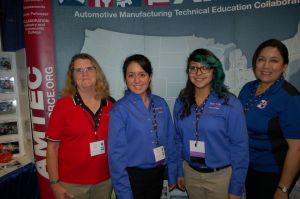
Mary Batch, assistant manager of Human Resource Development, Toyota Motor Manufacturing Texas Inc., St. Philips College students Selena Flores and Samantha Vera, and Danine Tomlin, executive director of the Automotive Manufacturing Technical Education Collaborative (AMTEC), presented information about the Advanced Manufacturing Technology curriculum that AMTEC developed with Toyota at the 2015 ATE Principal Investigators Conference in Washington, D.C.
At this point in the story, Flores nods her head matter-of-factly explaining that she and Vera learned basic manufacturing skills in the Alamo Area (Dual-Credit) Academies while in high school. In just one course they learned to operate a CNC machine, a milling machine, a drill press, a chop saw, and a band saw.
Mary Batch, assistant manager of Human Resource Development, Toyota Motor Manufacturing Texas Inc., and Danine Tomlin, executive director of the Automotive Manufacturing Technical Education Collaborative (AMTEC), were in the exhibit hall booth with Flores and Vera to answer questions about the St. Philips College AMT AAS Degree. The degree program’s curriculum is aligned to AMTEC’s national standards, and was developed by industry and college partners to address Toyota’s mechatronics/multi-skilled technician needs.
For biotechnology student Kim Lantrip the thrill of participating in scientific discovery happened during the second semester of her biotech program at Flathead Valley Community College.
The molecular procedure for identifying wildlife species that she and classmate Brad Dixon devised and tested during spring 2015 semester is helping to determine whether Canada lynx and wolverine, two threatened species, are living in the Lost Trail National Wildlife Refuge in Montana. The animals have been seen, but a wildlife biologist needs physical evidence to seek “critical habitat” designation of the 7,885-acre refuge.
“It’s incredibly motivating, because I’m doing something that has obvious implications. I can assist this range in becoming a critical habitat, which would then help the animals,” Lantrip explained last week in Washington, D.C. She was among the 60 students from across the U.S. and Guam who shared their learning experiences at the 2015 Advanced Technological Education Principal Investigators Conference in Washington, D.C., October 21 to 23.
In the lab at Flathead Valley Community College student Kim Lantrip prepares a fur sample for tests to determine if it has Canada lynx DNA.
The laboratory procedure that Lantrip and Dixon developed first isolates the mitochondrial DNA from fur left by the animals whose bodies rub along the fur traps placed at the direction of Beverly Skinner, a wildlife biologist at the refuge.
For help to identify fur samples to confirm the presence of a lynx population Skinner contacted Ruth Wrightsman, a biology instructor at FVCC and the principal investigator of an ATE grant that supported development of the biotechnology transfer degree program at the rural college. In 2002 the college received a MentorLinks grant from the American Association of Community Colleges to strengthen its natural resources programs. Both the ATE grant and the MentorLinks grant were funded by the National Science Foundation.
Wrightsman made the biologist’s question a project for her spring Biotechnology 205 course. The major assignment was coming up with an accurate, repeatable molecular method for identifying wildlife species.


 bicycle-style hand brake that is level with Kimmel’s lap as he sits in his wheelchair. With this innovation Kimmel and other manufacturing technicians with limited mobility do not have to stretch from their wheelchair seats past moving spindles and blades to shut off the milling equipment. Dalton Relich, the machinist and technical assistant at HERL, said brakes on mills have been above the shoulders of standing operators for hundreds of years.