One of Samantha Vera’s favorite stories about her friend and classmate Selena Flores is how she helped an engineer build and operate a piece of equipment in their first semester of the Advanced Manufacturing Technology Program (AMT) at St. Philips College.
“He went to a university, and we went to a community college, and she put it all together,” Vera said.
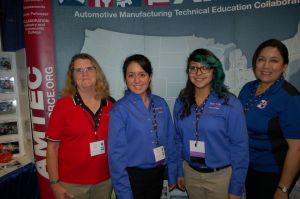
Mary Batch, assistant manager of Human Resource Development, Toyota Motor Manufacturing Texas Inc., St. Philips College students Selena Flores and Samantha Vera, and Danine Tomlin, executive director of the Automotive Manufacturing Technical Education Collaborative (AMTEC), presented information about the Advanced Manufacturing Technology curriculum that AMTEC developed with Toyota at the 2015 ATE Principal Investigators Conference in Washington, D.C.
At this point in the story, Flores nods her head matter-of-factly explaining that she and Vera learned basic manufacturing skills in the Alamo Area (Dual-Credit) Academies while in high school. In just one course they learned to operate a CNC machine, a milling machine, a drill press, a chop saw, and a band saw.
Mary Batch, assistant manager of Human Resource Development, Toyota Motor Manufacturing Texas Inc., and Danine Tomlin, executive director of the Automotive Manufacturing Technical Education Collaborative (AMTEC), were in the exhibit hall booth with Flores and Vera to answer questions about the St. Philips College AMT AAS Degree. The degree program’s curriculum is aligned to AMTEC’s national standards, and was developed by industry and college partners to address Toyota’s mechatronics/multi-skilled technician needs.
For biotechnology student Kim Lantrip the thrill of participating in scientific discovery happened during the second semester of her biotech program at Flathead Valley Community College.
The molecular procedure for identifying wildlife species that she and classmate Brad Dixon devised and tested during spring 2015 semester is helping to determine whether Canada lynx and wolverine, two threatened species, are living in the Lost Trail National Wildlife Refuge in Montana. The animals have been seen, but a wildlife biologist needs physical evidence to seek “critical habitat” designation of the 7,885-acre refuge.
“It’s incredibly motivating, because I’m doing something that has obvious implications. I can assist this range in becoming a critical habitat, which would then help the animals,” Lantrip explained last week in Washington, D.C. She was among the 60 students from across the U.S. and Guam who shared their learning experiences at the 2015 Advanced Technological Education Principal Investigators Conference in Washington, D.C., October 21 to 23.
In the lab at Flathead Valley Community College student Kim Lantrip prepares a fur sample for tests to determine if it has Canada lynx DNA.
The laboratory procedure that Lantrip and Dixon developed first isolates the mitochondrial DNA from fur left by the animals whose bodies rub along the fur traps placed at the direction of Beverly Skinner, a wildlife biologist at the refuge.
For help to identify fur samples to confirm the presence of a lynx population Skinner contacted Ruth Wrightsman, a biology instructor at FVCC and the principal investigator of an ATE grant that supported development of the biotechnology transfer degree program at the rural college. In 2002 the college received a MentorLinks grant from the American Association of Community Colleges to strengthen its natural resources programs. Both the ATE grant and the MentorLinks grant were funded by the National Science Foundation.
Wrightsman made the biologist’s question a project for her spring Biotechnology 205 course. The major assignment was coming up with an accurate, repeatable molecular method for identifying wildlife species.
Exploring Advanced Manufacturing—an interactive, online course—offers an overview of manufacturing to help high school and two-year college students decide which type of manufacturing fits their interests and talents.
The course was created by two Advanced Technological Education centers with support from the National Science Foundation. CA2VES, The Center for Aviation and Automotive Technology Education using Virtual E-Schools, provided the research based-instructional design of the six-module course. FLATE, the Florida Advanced Technological Education Center of Excellence, provided the manufacturing content.
Exploring Advanced Manufacturing is a free modular course at EducateWorkforce.com.
“FLATE is extremely proud of this product,” said Marilyn Barger, executive director and principal investigator of FLATE.
“Although FLATE has not been charged with creating content, we were able to leverage our own content expertise with CA2VES ‘ expertise in online learning. We are able to provide this open access introductory course to individuals and educators across the country through our collective stakeholders.
“With Manufacturing Day just around the corner on October 2, we hope many educators and students will take advantage of this state-of-the-art, free resource,” Barger said.
When she makes a photonics recruiting presentation to women and girls, Carolyn Hulla-Meyer explains engineering in way that makes them see immediately that they can do it.
She asks them if they are crafters. Do they like to get on Pinterest? If they do, then, she says, “OK. That’s a lot like engineering. You’re just not told it’s engineering. It’s called crafting when you do it.ˮ
“It’s just about staring those stereotypes in the face. Calling them out and then flipping them around so that the student can see it for what it is,ˮ she explains.
Dan Hull, OP-TEC’s principal investigator, points out that the capacity of optical fibers to carry massive amounts of data in the form of light through hair-thin flexible strands of glass or plastic enables other technical advances. These include faster Internet speeds and enhanced endoscopic medical procedures.
Nevertheless, Hulla-Meyer is proud that the four white male students who graduated in May 2015 are being replaced by four students from underrepresented populations. Two of the incoming students are women—the program’s second and third female students since 2006. The other new students are an African American man and a Hispanic man.
All the outreach specialists are using posters, events, and other collaterals developed to celebrate 2015 as the International Year of Light in their presentations. In Cincinnati, Hulla-Meyer is reaching out to the Cincinnati Zoo & Botanical Garden for the college’s laser and optics program to have a role in the Festival of Lights, the Christmas holiday light show that attracts thousands of visitors to the zoo each year from November to January.
Indian River State College where LASER-TEC is located has already had two large public conferences to mark the International Year of Light. More than 250 teenagers, parents, and teachers attended the events where lasers, infrared technologies, fiber optics, integrated photonics, and other light-based technologies were explained by national experts.