Faculty at Seminole State College of Florida hope to “green” technical students’ skills and expand non-science majors’ knowledge of environmental science in ways that pique their interest in STEM careers.
Principal Investigator Jason Gaschel hopes the certificate program, which begins in Fall 2015, will help graduates differentiate themselves when they look for jobs and provide a framework for his college and others to add environmental sustainability content throughout their programs.
High school students use 3-D modeling and other technologies to create solar-powered vehicles capable of crossing obstacle courses during the 2015 Career Pathways summer workshops on alternative energy at Seminole State College.
Gaschel, interim associate dean of the Center for Engineering and Design at Seminole State, has taught about hybrid vehicle technologies and is interested in alternative fuels for autos and homes. For several years he and his colleagues have discussed the possibility of creating a program for alternative energy technicians.
However, their conversations with employers did not find a strong demand for technicians who focus exclusively on hybrid vehicles in automotive technology or alternative energy sources in construction technology.
“Green jobs are out there, but in emerging areas I do not see the data for alternative energy technicians,” Gaschel said, explaining that employers want technicians with “green” knowledge woven into their technical skills.
The contextualized math program for secondary and postsecondary students that Palm Beach State College (PBSC) is launching with a new Advanced Technological Education grant fits with the college’s strategic goal of boosting student retention and completion.
The new Intermediate Algebra course for postsecondary students will incorporate tactile experiences and authentic math problems from the college’s Electrical Power Technology (EPT) and Engineering Technology (ET) associate of science degree programs.
Jay Matteson, principal investigator of the InnovATE project supported by the ATE grant, hopes the contextualized math will assist students—both teens and older adults—entering the EPT and ET programs with intellectual scaffolding that ignites their interest in STEM careers and fortifies their learning so they can succeed in college.
The InnovATE project aims to improve STEM learning and increase STEM career interest among the students enrolled in high-yield middle and high schools, defined as Title I schools, that serve as key parts of PBSC’s student pipeline. Currently, the Algebra I passage rate is only about 50% at the six high schools that the InnovATE project targets.
“If you can’t pass math, you can’t get to the degree program,” Matteson said, summing up PBSC’s challenge and the nation’s challenge with recruiting and retaining underserved populations in STEM fields.
Madeline authored a report about the successes of the National Information, Security and Geospatial Technologies Consortium and its partner colleges’ work in networking and data communications, cybersecurity, programming, and geospatial technologies.



 oosting student retention and completion.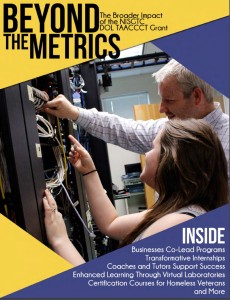

 for 15 students this fall.