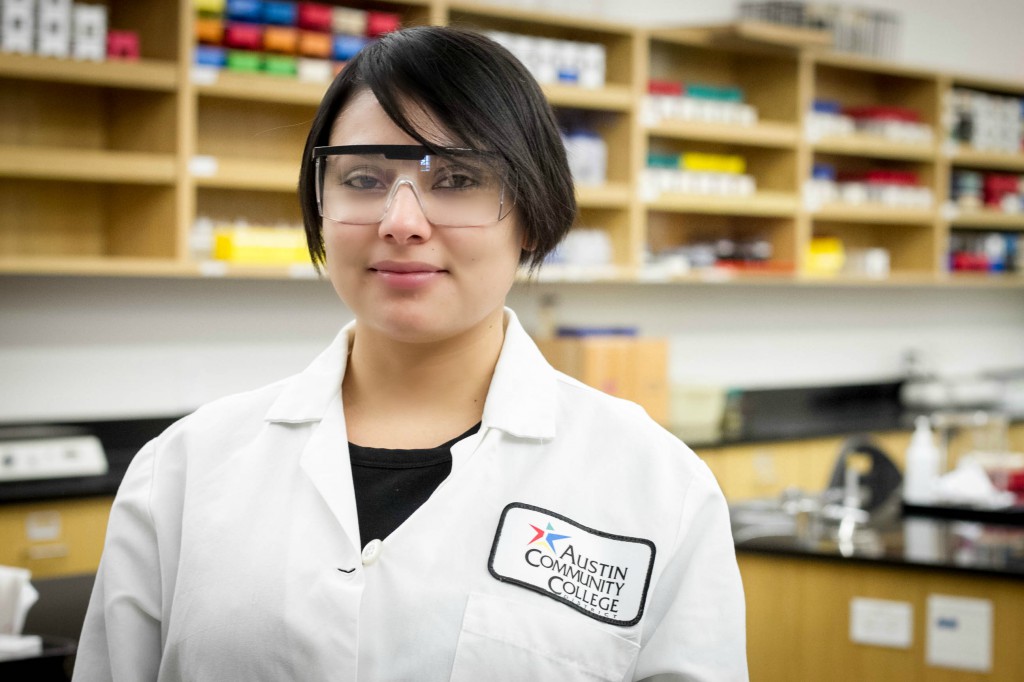
The authentic biotech lab experiences Sonja Lopez-Tellez had as an Austin Community College student will become more plentiful when the college opens a $4.9 million biotech research wet lab in 2016.
The small, but real, work projects Sonja Lopez-Tellez completed as a biotech student at Austin Community College (ACC) in Texas helped her succeed in two internships, with the second at XBiotech leading to a full-time job.
Authentic work experiences are something ACC biotech students will get a lot more of when the college opens a new $4.9 million biotech research wet lab with business incubator space.
ACC is the first two-year college to receive such significant funds from the Texas Emerging Technology Fund Research Award program. The ACC Biotech Department’s application with the support of a dozen community and corporate partners is a bold effort to address the shortage of wet labs that biotech start-up companies need to fine tune their new products and production processes for them.
“Once a company has discovered the value of using our interns to do projects, they ask for more. That is the bottom line … because we get things done for them that would normally cost them quite a bit of money. And we can accelerate their product development,” said Linnea Fletcher, chairman of the ACC’s Biotechnology Department. Fletcher has been the principal investigator of two National Science Foundation Advanced Technological Education (ATE) grants and the co-principal investigator of ATE grants for Bio-Link, a National Advanced Technology Education Center of Excellence focused on Biotechnology and Life Sciences at City College of San Francisco.
The peer mentoring was so dynamic during the Bridges to STEM Careers project at the Bay Area Video Coalition that the San Francisco non-profit will give peer mentors more prominent roles in its new Next Generation Bridges Fellowship.
The fellowship program, which begins this summer, will sustain peer mentoring along with other successful aspects of the recently concluded Bridges to STEM Careers project that was funded by the National Science Foundation’s Advanced Technological Education program.
For the mentors’ take on Bridges see BAVC’s “The Role of Peer Mentors” video. It is one of nine three-minute video vignettes that BAVC produced with ATE grant support to inform underrepresented students and their families about media arts and technology careers, and the process for gaining entry to them.
The notion of family as a motivation, inspiration, and support comes up again and again when Marcus Maximin talks about the four-year maritime technology apprenticeship program at Tidewater Community College.
He acknowledges it can be “tough” working eight-to-10 hour days and then going to class two evenings a week.
“To tell you the truth, what keeps me going is my two boys. They are 12 and 4. And every time I walk in that door I get a hug and that, “Daddy!” That keeps me going. I do it for them,” he explained.
The remotely operated vehicle competition sponsored by the Marine Advanced Technology Education (MATE) Center has a pivotal role in two movies and a new book. It is the backdrop for Spare Parts, a feature film being released in January, a new book with the same title, and Underwater Dreams, a documentary released in theaters this past summer.
The central plot feature of all these works is MATE’s remotely operated vehicle (ROV) competition in 2004 when the underwater robot constructed by a team of immigrant Hispanic students from a Phoenix high school beat other high school, community college and university teams, including the Massachusetts Institute of Technology.
Jill Zande, MATE’s associate director and coordinator of the center’s ROV competition, is working with the feature film’s marketing team to attract attention to the center’s educational activities and marine technology careers.
“We’re excited that the films and book are calling attention to STEM programs and the powerful impact that they can have on students and student learning. They also demonstrate what students—no matter what their background or socioeconomic status—are capable of when given the opportunity,” Zande said.
The MATE Center’s Facebook page currently includes a video summary of the 2004 competition (Carl Hayden Community High School’s champion ROV appears at 4:12).The trailer for the Hollywood version starring George Lopez, Carlos PenaVega, Jamie Lee Curtis, and Marissa Tomei is online too.